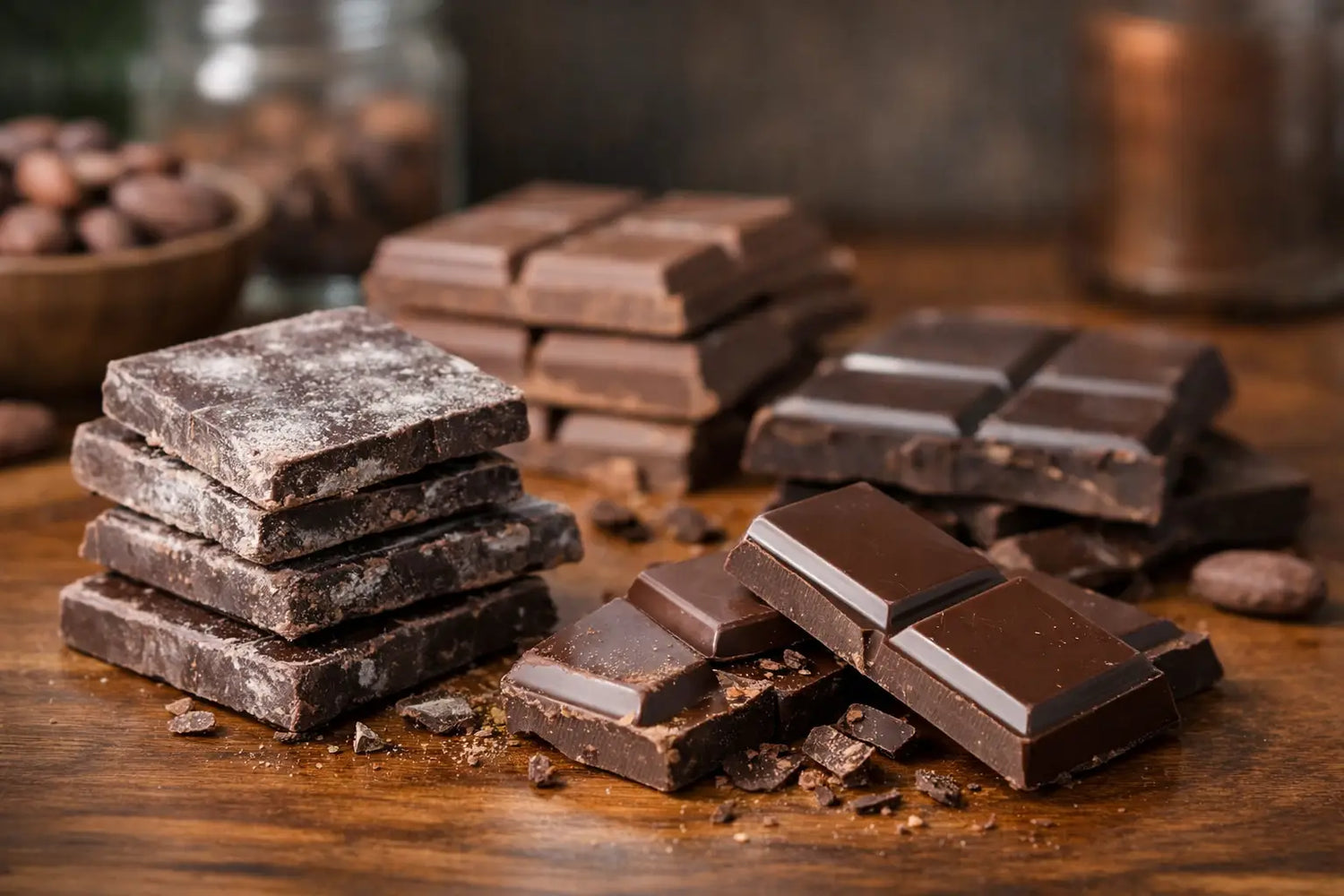
A beautifully made chocolate bar should break with a clean snap and reveal a smooth, even sheen. So when a pale, dusty-looking film appears on its surface, it can feel disappointing, especially when the chocolate was chosen as a gift or saved for a special moment. Why does chocolate bloom? Usually, it is the visible result of changes in the cocoa butter or sugar after the chocolate has been made; not a sign that the chocolate has spoiled.
Bloom is one of the most common questions in fine chocolate, and it is worth understanding because appearance alone does not tell the whole story. A bloomed bar may still be perfectly safe and enjoyable to eat. Yet bloom can affect texture, aroma, and the elegant finish that careful bean-to-bar chocolate making is designed to achieve.
Why does chocolate bloom?
Chocolate bloom occurs when ingredients inside the chocolate move or react at the surface. There are two distinct kinds: fat bloom and sugar bloom. They can look similar at first glance, but they have different causes and leave different clues.
The first thing to know is that bloom is not mold. Mold tends to look fuzzy, irregular, or greenish, and may come with an off smell. Bloom is typically dry-looking, pale gray, or whitish, with no unusual odor. If chocolate has been kept for a very long time, smells stale, or has been exposed to contamination, it is wise to discard it. But bloom on otherwise well-kept chocolate is generally a quality issue, not a food-safety concern.
Fat bloom: a change in cocoa butter crystals
Fat bloom is the more familiar form. It often appears as a gray haze, cloudy streaks, or light patches across the surface. It happens when cocoa butter migrates through the chocolate and recrystallizes on the outside.
Cocoa butter is remarkable because it can form several different crystal structures. Proper tempering encourages the most desirable structure, which gives chocolate its gloss, firm snap, and melting character. When chocolate becomes too warm, experiences repeated temperature changes, or is stored for an extended period, those stable crystals can shift. Some cocoa butter separates and rises to the surface, where it forms visible crystals.
This does not mean the chocolate was poorly made. Even expertly tempered chocolate can develop fat bloom after a difficult journey through warm delivery conditions, an overheated kitchen, or repeated moves between a cool room and a warm one. Chocolate containing fillings, nuts, or certain inclusions may also be more susceptible because fats from those ingredients can interact with the cocoa butter over time.
Fat bloom usually makes chocolate less satisfying rather than unsafe. The bar may feel softer, waxier, or slightly grainy on the tongue. Its flavor is still present, but the clean melt and polished appearance may be diminished.
Sugar bloom: moisture is the culprit
Sugar bloom has a rougher, more powdery appearance. Rather than a smooth gray haze, it can look like tiny white crystals or a chalky coating. It occurs when moisture reaches the chocolate.
A little condensation can dissolve sugar at the surface. When that moisture evaporates, the dissolved sugar recrystallizes in a visible, uneven layer. Refrigeration is a common trigger when cold chocolate is unwrapped before it has had time to warm gradually. Humid conditions, damp packaging, and direct contact with water can cause the same problem.
Sugar bloom tends to have a more noticeable effect on texture than fat bloom. The chocolate may taste gritty or feel sandy at the first bite. This is why a refrigerator is not automatically the best home for fine chocolate, despite seeming like the safest place to keep it cool.
Is bloomed chocolate safe to eat?
In most cases, yes. Chocolate bloom does not create harmful compounds, and it is not an indication of bacterial growth. If the chocolate smells fresh, has been stored in clean conditions, and shows only the familiar pale surface coating, it is generally safe to eat.
The decision is often about pleasure rather than safety. A single-origin dark chocolate with delicate fruit, floral, or roasted notes deserves a smooth melt that allows its character to unfold gradually. Bloom can interrupt that experience. Milk chocolate and white chocolate may show bloom more visibly because their lighter color makes surface changes easier to see, while their milk-fat content can add another variable to storage stability.
Filled chocolates deserve a little more care. Pralines, truffles, and ganaches have shorter ideal storage windows than a plain bar because their centers may contain cream, fruit, butter, or other perishable ingredients. Bloom on the shell may still be harmless, but the filling should be considered separately. Follow the storage guidance provided with the product, and enjoy fresh filled pieces within their recommended timeframe.
What bloom reveals about chocolate craftsmanship
Bloom is often mistaken for proof that chocolate is inferior. The reality is more nuanced. Tempering, ingredient balance, molding conditions, packaging, transport, and storage all influence how chocolate ages. A maker can control the first stages with precision, but no chocolatier can fully control a bar once it enters a warm car, a sunny countertop, or a humid refrigerator.
That said, fine chocolate making does reduce the risk. In a bean-to-bar workshop, cacao is roasted, refined, conched, tempered, and molded with close attention at every stage. Tempering is especially exacting: the chocolate must be heated and cooled through a controlled temperature curve so the cocoa butter forms stable crystals. It is a technical process, but the result is sensory - shine, snap, and a smooth, even melt.
High-quality ingredients also matter. Chocolate made with carefully sourced cacao and a short, purposeful ingredient list allows the character of the beans to come through clearly. It may not be engineered for the unusually long shelf life expected of mass-market confectionery, but it offers something more direct: the flavor and texture created by real cacao, careful craft, and transparent sourcing.
How to prevent chocolate bloom at home
Chocolate is happiest in a cool, dry, dark, and stable place. For most homes, a pantry or cupboard away from the stove, dishwasher, and direct sunlight is better than the refrigerator. An ideal range is roughly 15° to 20° Celsius (60 to 68°F), with low humidity and minimal temperature fluctuation.
Keep chocolate in its original wrapper or in an airtight container. This protects it from humidity and from strong aromas. Cocoa butter readily absorbs odors, so chocolate stored beside coffee, spices, onions, or scented foods may lose some of its intended flavor.
If your home is consistently hot, refrigeration may be necessary. In that case, place the chocolate in an airtight container before chilling it. When you are ready to enjoy it, leave the container closed on the counter until the chocolate reaches room temperature. This gradual warming prevents condensation from forming directly on the surface and greatly reduces the chance of sugar bloom.
Avoid leaving chocolate in a car, carrying it unprotected on a warm day, or repeatedly moving it between cold and warm environments. A single dramatic melt can cause trouble, but small daily swings can also slowly disrupt the cocoa butter crystal structure.
Can you fix bloomed chocolate?
You cannot restore a bloomed bar to its original polished appearance simply by cooling it again. Once the cocoa butter or sugar crystals have changed at the surface, the visual finish will remain. For eating, that may not matter at all. A bloomed bar can still make a comforting afternoon treat, and a little surface haze does not erase the work behind the cacao.
For baking, bloomed chocolate is often an excellent choice. Melt it into brownies, cookies, cakes, hot chocolate, or a sauce, where the altered surface texture disappears. If you are comfortable working with chocolate, melting and tempering it again can restore a smoother finish, though this requires careful temperature control and is best suited to plain chocolate rather than filled pieces.
The most helpful approach is not to judge chocolate by a pale surface alone. Break off a piece, notice the aroma, and taste it. When chocolate has been stored with care, its flavor can still offer a generous reminder of the cacao, the maker, and the pleasure of taking a moment for something made well.